For three weeks after my voiceover website went live, I felt like I'd crossed a finish line. Three languages, real photos, a working contact form, done. I told everyone. I posted about it. In my head, the project was over.
None of it would exist in the first place without my friend Christopher, a real mastermind when it comes to software and web development. Long before launch, I'd spent ages hunting for a website designer who felt like some kind of magician, someone who could somehow understand both the voiceover world and my very particular taste for detail. Christopher was the one who finally told me to drop that search entirely and just build it myself, from scratch, with Claude's help. So really, this whole story starts with him talking me out of my own perfectionism, and it didn't stop there.
Right around that three-week mark, he asked me a question that quietly ruined my victory lap: "Have you run a Lighthouse audit yet?"
I hadn't. I didn't even know what that meant.
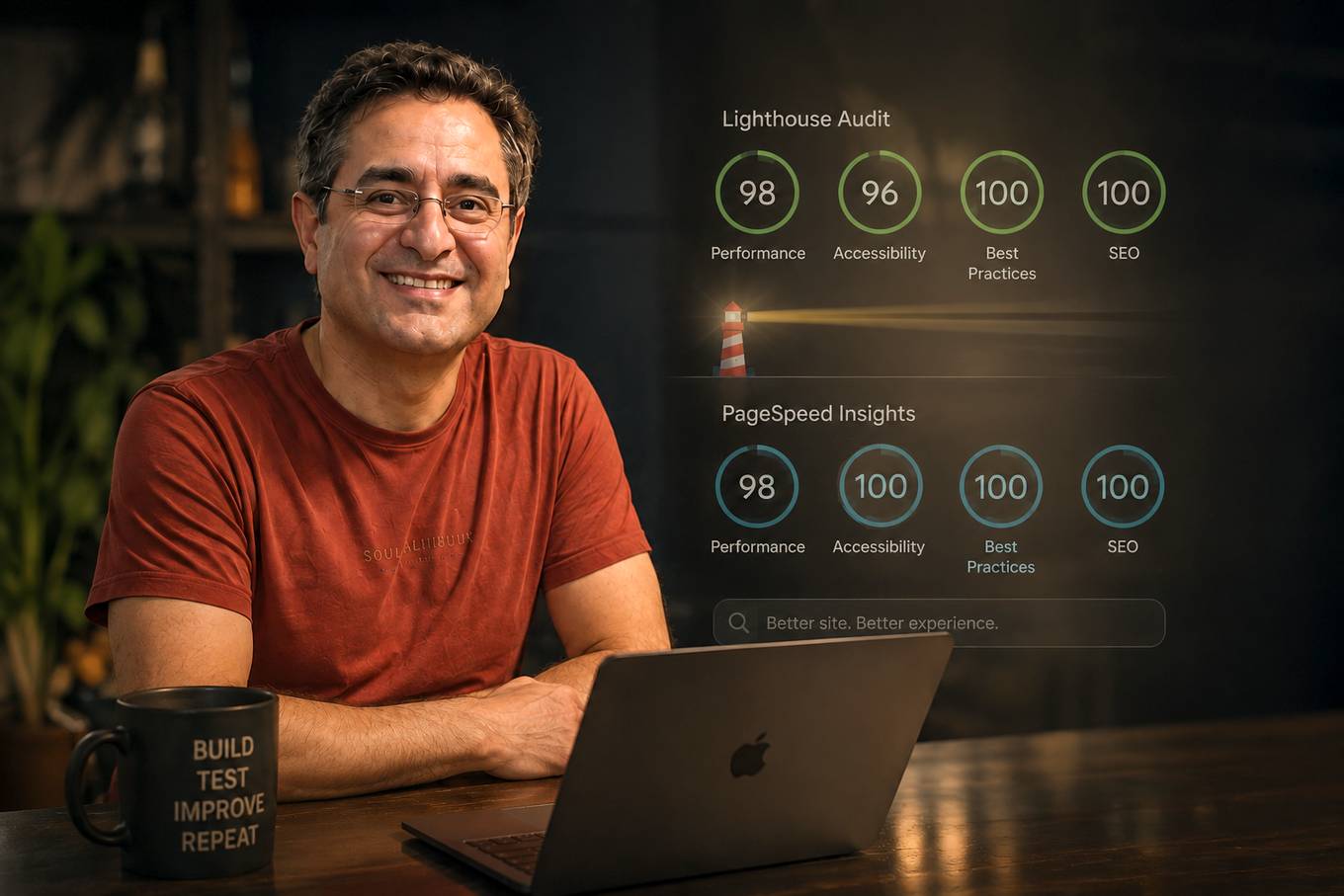
Turns out Lighthouse is a tool built right into browsers like Chrome that grades a website across a few categories: how fast it loads, how accessible it is for people using screen readers or other assistive tools, whether it follows web best practices, and how well search engines can actually find it. Christopher walked me through my first Lighthouse audit, and for the first time I saw my "finished" site broken down into real numbers instead of just a feeling of pride.
Here's the part that caught me completely off guard. I ran the same test in two different browsers, Brave and Edge, and got two different scores. Same website, same day, same everything, but Brave gave it a slightly lower "Best Practices" score than Edge did. My first reaction was panic. My second reaction, with some help sorting through it, was realizing that browsers themselves can get in the way of an honest test. Brave runs its own privacy shields quietly in the background, and that was the actual reason for the gap, not a real problem with my site.
That's the moment website testing stopped feeling like a chore and started feeling like detective work.
I didn't know a cleaner option even existed, but Claude pointed me toward PageSpeed Insights, a tool that tests from Google's own servers rather than through whatever extensions happen to be running on your computer. I ran the site through it, and it caught something real: my own security settings were quietly blocking Google Analytics from properly tracking visitors. Nothing dramatic, but a real problem, and one the browser-based scores alone hadn't made obvious. Once it was fixed, the numbers cleaned up, and more importantly, so did the actual data coming in.
Somewhere in the middle of all this, something shifted for me personally. I'd heard terms like "CSS," "JS," and other technical jargon for probably two decades without ever really knowing what any of them meant. They always sounded like something only real developers were allowed to touch. But once I was staring at my own site's colors, my own contrast issues, my own real numbers changing in real time because of a change I made, they stopped being abstract, intimidating words. They became tangible. And tangible things, it turns out, are a lot less scary than words that have just been floating around in your head for twenty years. It was also my real introduction to web accessibility, and I don't think I'll ever look at a color palette the same way again.
These days the site scores in the high nineties and above across the board, and that number means a lot to me.
Looking back, both of them shaped this more than they probably realize. Christopher pushed me past my own perfectionism twice: once to stop searching for that dream designer and just build this myself, and again to actually test what I'd built instead of assuming "live" meant "finished." He had the patience to explain things without ever making me feel behind. And Claude was there for every single fix that came after, translating what the numbers actually meant and helping me make real decisions instead of just guessing and hoping.
If you're building something of your own, whether it's a website, a portfolio, or anything with a "publish" button on it, here's the one thing I'd pass along: launching is not the finish line. It's closer to the starting gun. You don't need to become a developer to check your own work. A couple of free tools, one patient friend, and the willingness to feel a little lost while you learn is honestly enough to get started. If you've ever called something "finished" and later found out it wasn't, I'd genuinely like to hear about it. Reach out and tell me what you found.